CorTec Brain Interchange closed-loop BCI system
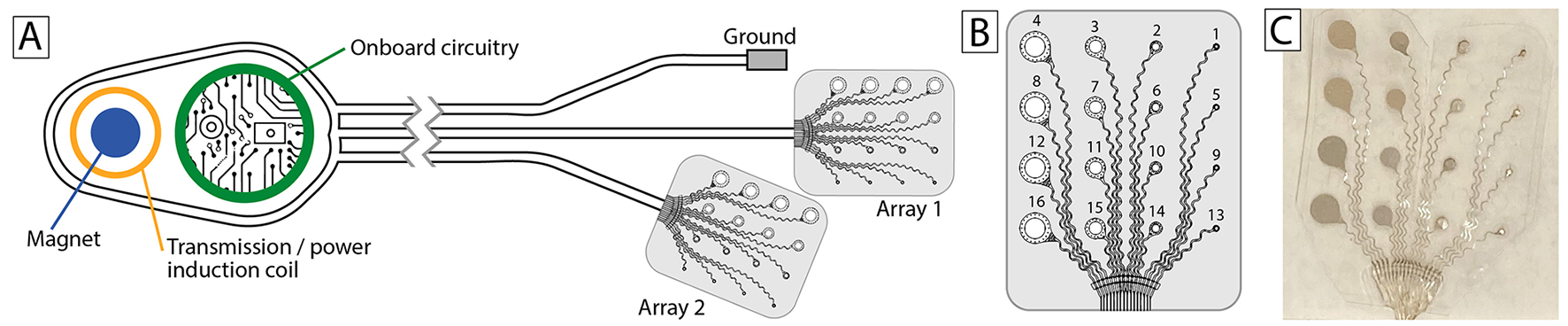
Brain Interchange system and AirRay arrays documented in a 2022 canine-model study; the figure combines a system diagram with electrode photography.
Published research configuration; do not assume it is identical to the 2025 human-study implant.
Image credit & source
Schalk, Worrell, Mivalt, Belsten et al., Frontiers in Neuroscience (2022), Figure 1 · Frontiers in Neuroscience · Figure 1 · CC BY 4.0.
Original complete research figure copied byte for byte to local storage; no crop, resizing or re-encoding. Original panels, annotations and scale bars retained.
- Code
- C3R
- Reviewed
- 2026-10-22
- Interface
- ecog
- Evidence stage
- human
Independent, source-linked catalog sheet. Not a manufacturer-issued datasheet, regulatory decision or instructions for clinical use. Human evidence does not establish approval. Source-specific restrictions, conflicts and missing specifications are retained below.
CorTec Brain Interchange
CorTec (Freiburg, Germany) describes Brain Interchange as a fully implantable, wireless, closed-loop system for pre-clinical and clinical research toward therapies for neurological diseases. It holds two FDA Breakthrough Device Designations (second announced Aug 31, 2026) and is described by the company as the first European implantable BCI with an FDA-approved (IDE) US trial, lead indication stroke rehabilitation.
Identity
| Field | Value and source scope |
|---|---|
| Device | Brain Interchange System [1][2] |
| Manufacturer | CorTec GmbH, Freiburg im Breisgau, Germany [1] |
| Interface class | Cortical surface: silicone contact mats placed directly on the brain, electronics between skull and scalp (co-founder Martin Schuttler, Badische Zeitung interview) [4] |
| First human implant | Reported: stroke patient, late July 2025 (BioWorld) [3] |
| Regulatory status | Investigational; two FDA Breakthrough Device Designations, FDA-approved (IDE) US trial (company) [2] |
| Function | Closed-loop recording and stimulation [1][2] |
| Lead indication | Stroke rehabilitation (company) [2] |
Human use so far
- A University of Washington lab reported cursor control by its first participant (Apr 2026) [5].
- In an Oct 2026 Badische Zeitung interview, Schuttler said stroke patients steered the computer game Pong by thought alone and that targeted stimulation supported relearning of movements; regional-press interview, not peer reviewed [4].