CWRU/Ardiem self-sizing spiral nerve cuff
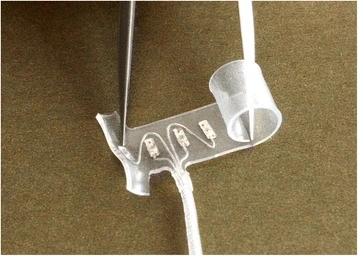
CWRU/Ardiem standard self-sizing spiral cuff: nominal 4 mm diameter and four radial contacts. It wraps a peripheral nerve.
2017 standard four-contact family specimen. This photograph does not identify a particular participant’s implanted cuff or establish the geometry of every cuff diameter.
Image credit & source
Photo courtesy of Ardiem Medical, Inc.; Christie et al., Journal of NeuroEngineering and Rehabilitation (2017), Figure 1 · JNER · Figure 1 · CC BY 4.0.
Whole published photograph re-encoded without cropping or upscaling. Original Ardiem attribution retained.
- Code
- ?3R
- Reviewed
- 2026-02-06
- Interface
- pni
- Evidence stage
- human
Independent, source-linked catalog sheet. Not a manufacturer-issued datasheet, regulatory decision or instructions for clinical use. Human evidence does not establish approval. Source-specific restrictions, conflicts and missing specifications are retained below.
CWRU/Ardiem spiral cuff
These sheets cover the same self-sizing cuff design family. The standard four-contact photograph appears once; the sensory study is a deployment record, not a second cuff architecture. The ITIS 33-contact prototype has its own catalog entry.
Related study records (2)
- CWRU/Ardiem self-sizing spiral nerve cuff Standard self-sizing design family, with the credited four-contact reference photograph.
- CWRU self-sizing spiral nerve cuff (upper-limb sensory stimulation research deployments) Upper-limb sensory research deployment; exact participant hardware is not identified by the standard reference photograph.
CWRU/Ardiem self-sizing spiral nerve cuff
This sheet covers the CWRU/Ardiem self-sizing cuff design family. The upper-limb sensory sheet is a study record of that family. The ITIS 33-contact cuff is a separate architecture.
Every field follows the shared implant-device template. Values belong to a named configuration or study; not reported means the reviewed sources do not establish the value. Family-wide and deployment-specific evidence are kept separate.
Identity
| Field | Value and source scope |
|---|---|
| Device | Self-sizing spiral nerve cuff family |
| Manufacturer | CWRU design; Tan 2015 implanted components manufactured by Ardiem Medical. Not one universal vendor SKU |
| Interface class | Extraneural peripheral nerve stimulation cuff |
| Origin | Naples, Mortimer, Scheiner and Sweeney design; cited in Christie 2017 |
| First demonstrated | 1988 design publication cited in Christie 2017; earliest implant date not established here |
| First human implant | Human implants since 2005 in Christie 2017 cohort; not claimed as first-ever human implantation |
| Species studied | Human in Christie 2017 and Tan 2015; earlier animal evidence cited, not re-audited here |
| Regulatory status | Research implants; Tan 2015 reports FDA Investigational Device Exemption, not commercial approval |
| Function | Motor and sensory peripheral nerve stimulation |
| Target tissue | Peripheral nerve surface outside epineurium |
Geometry and architecture
| Field | Value and source scope |
|---|---|
| Interface type | Non-penetrating self-curling spiral cuff |
| Array layout | Self-curling polymer sheath wraps nerve twice, Christie 2017; contacts distributed around circumference |
| Electrode count | One to four independent stimulation contacts per cuff in Christie 2017; monopolar versions connect four contacts in series |
| Pitch | Configuration dependent; no universal pitch |
| Electrode lengths | Not applicable to penetrating shanks; cuff axial length not reported in audited descriptions |
| Shank width and thickness | Not applicable; cuff diameter selected intraoperatively from 2-10 mm inventory, Christie 2017 |
| Tip and exposed site geometry | Configuration dependent; Tan 2015 radial spiral: four contacts, 4 mm cuff diameter; exposed area not reported |
| Contact coating | |
| Insulation | Self-curling polymer sheath, Christie 2017; composition and thickness not established in audited Methods |
| Insertion method | Surgical nerve exposure and wrapping around nerve, without epineurial penetration |
| Anchoring and fixation | Self-sizing wrap can secure without sutures, Christie 2017; redundant lead length matters for strain relief |
Electrode and channel physics
| Field | Value and source scope |
|---|---|
| Exposed site area | |
| Electrode material | |
| Impedance (with measurement frequency) | Tan 2015 radial spiral in subject 1: 2.91 ± 0.22 kΩ. Derived from voltage drop with 0.3 mA, 50 µs pulses at 20/100 Hz, not 1 kHz spectroscopy |
| Noise floor or SNR | |
| Recording modality | Recording capability not reported in reviewed deployments; these are stimulation studies |
| Sampling rate | Not applicable to passive cuff stimulation; controller acquisition is system-specific |
| Stimulation capability | Constant-current charge-balanced biphasic stimulation in Christie 2017. IST supports 1-255 µs and 0.1-20 mA, but study generally limits current to 2.1 mA or less; not a cuff safety rating |
| Charge injection limit | Not given as material injection limit; study stimulus settings are not a charge-injection limit |
| Reference and ground | Christie 2017: titanium implanted stimulator case is common return. Tan 2015 uses external UECU and percutaneous leads; do not conflate assemblies |
Tissue interface and bioresponse
| Field | Value and source scope |
|---|---|
| Target tissue | Extraneural peripheral nerve surface |
| Insertion trauma and BBB disruption | BBB: not applicable; cuff does not breach epineurium, Christie 2017. Quantitative surgical nerve injury not reported |
| Vascular disruption risk | Quantitative risk not reported; proper fit and accommodation of nerve size are design concerns, not a validated low-risk rating |
| Micromotion sensitivity | Lead tension implicated in one cuff pulling off thoracodorsal nerve, Christie 2017 |
| Gliosis and encapsulation | Peripheral nerve, not CNS gliosis; quantitative fibrosis histology not reported in reviewed human studies |
| Neuron loss near sites | |
| Foreign-body response mitigation | Self-sizing construction accommodates differing nerve sizes; no quantitative mitigation efficacy established |
| Typical failure modes | Christie 2017: one cuff pulled off nerve, attributed to possible lead tension; one contact in active cohort nonfunctional |
System architecture
| Field | Value and source scope |
|---|---|
| Onboard electronics | None in cuff; separate implanted stimulator-telemeter in Christie 2017 |
| Data path | Cuff lead to implanted IST in Christie 2017; Tan 2015 sensory system instead uses percutaneous leads to external UECU |
| Telemetry bandwidth | |
| Sampling rate | Configuration dependent; not an electrode-only specification |
| Power | Christie 2017 IST receives external inductive radiofrequency power/control. Tan 2015 uses external stimulator |
| Thermal management | |
| Packaging and hermeticity | Passive cuff plus separately packaged stimulator; hermetic qualification not reported in audited descriptions |
| MRI compatibility | |
| Surgical complexity | Peripheral nerve exposure, cuff sizing and lead routing; controller placement depends on system |
| Output connectors | Tan 2015: spring-sleeve connectors to open-helix percutaneous leads. Christie IST connector dimensions not reported |
Performance envelope
| Field | Value and source scope |
|---|---|
| Acute yield | Not given as uniform acute yield across configurations |
| Chronic yield | Christie 2017: 44 of 45 contacts functional in eight actively participating recipients; not 44/45 of all implanted contacts |
| Stability over time | Christie 2017: most thresholds stable; 20/27 monitored contacts increased by less than 5 nC/year |
| Longevity | Christie 2017 reports functional cuffs 2-11 years implanted; mean time since implant 6.7 ± 3.1 years. Not maximum rated lifetime |
| Revision and explant experience | Christie 2017: one IST explanted for perioperative infection after three months; cuffs remained implanted and operational at testing but inaccessible afterward |
| Adverse events | Christie 2017: one cuff pulled off nerve; perioperative infection involved IST, not cuffs. Tan 2015: no infection in reviewed period |
| Notable demonstrations | Femoral cuffs produced knee-extension moment sufficient for standing after 2-4.5 years; sensory feedback via radial spiral in one Tan 2015 participant |
Clinical and preclinical evidence
| Field | Value and source scope |
|---|---|
| Human subjects | Christie 2017: 14 people, 50 cuffs on 10 nerves; 13 SCI and one transradial amputee. Tan 2015 spiral is only the radial cuff in subject 1, not all cuffs in its two-person study |
| Preclinical cohort | |
| Follow-up duration | Christie: up to 11 years implanted, thresholds measured over up to 10.4 years. Tan: mixed cuff follow-up 1-2 years; do not assign all FINE outcomes to spiral |
| Indications | SCI motor restoration and limb-loss sensory restoration research |
| Trials and registries | Tan 2015 FDA IDE study; registry number not reported in audited Methods |
| Primary outcomes | Charge thresholds, recruitment curves, motor-unit overlap and sensory percept stability |
| Key limitations | Selected active participants, heterogeneous systems and nerves; contact-level denominator differs from total implanted cuffs |
Engineering tradeoffs
| Field | Value and source scope |
|---|---|
| Strengths | Human multi-year stimulation evidence without penetrating nerve fascicles |
| Limitations | Surface contacts preferentially access nearby fascicles; deep populations harder to isolate, Christie 2017 |
| Scaling constraints | Available nerve circumference, independently wired contacts and controller channels; no numerical ceiling established |
References
- Christie et al. 2017. Long-term stability of stimulating spiral nerve cuff electrodes on human peripheral nerves. Full Methods and Results.
- Tan et al. 2015. Stability and selectivity of a chronic, multi-contact cuff electrode for sensory stimulation in human amputees. Spiral cuff distinguished from FINE.