Innervace tissue-engineered nigrostriatal pathway
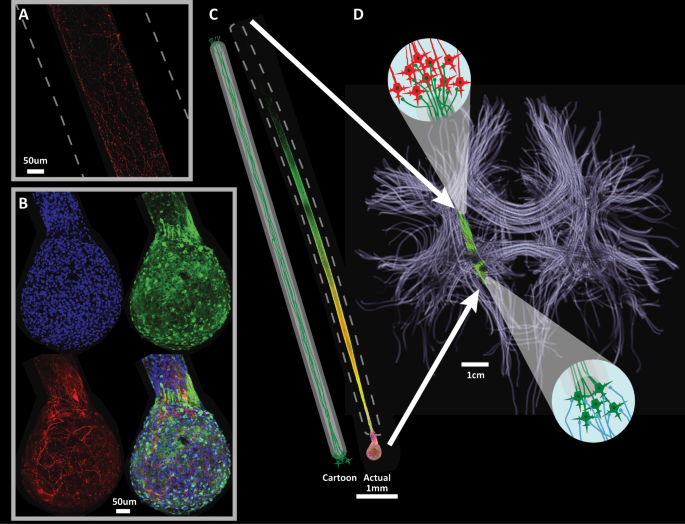
Dopaminergic micro-TENN constructs from the research program underlying Innervace; experimental microscopy and conceptual pathway reconstruction.
Preclinical Cullen Lab nigrostriatal tissue-engineering research; NOT a photograph of an Innervace clinical product.
Image credit & source
Harris, Burrell, Struzyna, Chen, Serruya, Wolf, Duda and Cullen, npj Parkinson's Disease (2020), Figure 4 · npj Parkinson's Disease · Figure 4 · CC BY 4.0.
Original complete research figure copied byte for byte to local storage; no crop, resizing or re-encoding. Original panels, annotations and scale bars retained.
- Code
- ?2R
- Reviewed
- 2026-10-22
- Interface
- other
- Evidence stage
- preclinical
Independent, source-linked catalog sheet. Not a manufacturer-issued datasheet, regulatory decision or instructions for clinical use. Human evidence does not establish approval. Source-specific restrictions, conflicts and missing specifications are retained below.
Innervace tissue-engineered nigrostriatal pathway
Innervace, a regenerative medicine startup co-founded by Penn Medicine’s Kacy Cullen and Douglas Smith, is developing what Penn Center for Innovation describes as the first implantable biofabricated neural pathway to restore damaged or diseased brain circuitry. Its lead program aims to reconstruct the lost nigrostriatal pathway in patients with Parkinson’s disease, using dopaminergic-phenotype cells in combination with a biofabricated scaffold pathway. The company closed a $40 million Series A (announced 2022) led by Deerfield Management.
Identity
| Field | Value and source scope |
|---|---|
| Device | Tissue-engineered nigrostriatal pathway (biofabricated neural pathway implant) [1][2] |
| Developer | Innervace (UPenn spin-out; technology from the Cullen/Smith groups) [1] |
| Interface class | Biohybrid cell-and-scaffold pathway reconstruction [1][2] |
| Regulatory status | In development; no clearance stated in the sources used here |
| Function | Reconstruction of the nigrostriatal pathway for Parkinson’s disease [1] |
| Stage | Preclinical/development; axonal tract reconstruction demonstrated in preclinical work [3] |